
Concrete Crack & Joint Repair in Des Moines, IA
Cracked, chipped, or uneven concrete needs to be properly repaired before any coating goes down — we handle that prep work as part of every installation, or as a standalone repair.
- Free On-Site Quotes
- Locally Focused on Des Moines
- Industrial-Grade Materials
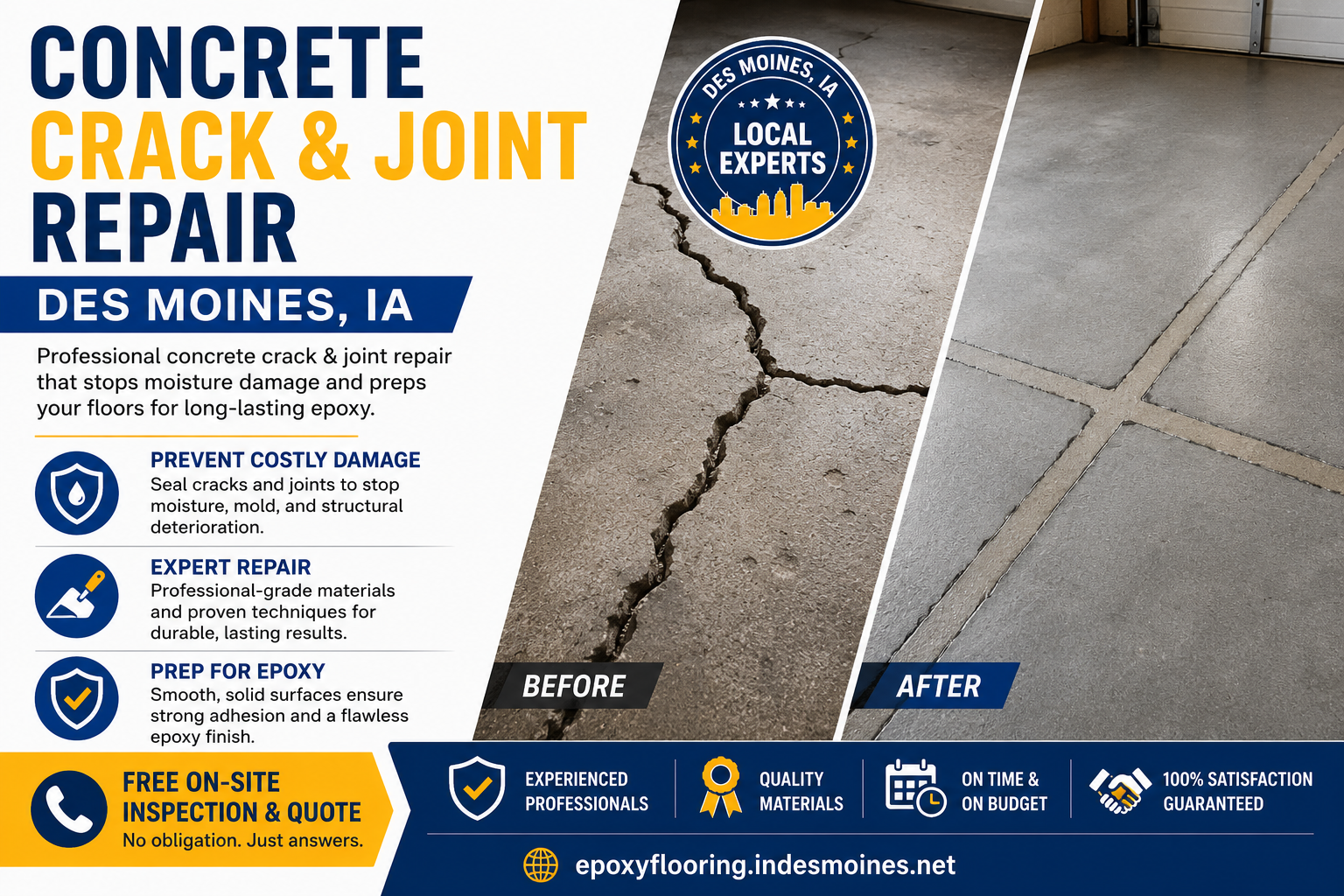
Why Choose Our Concrete Crack & Joint Repair Service
- Proper prep prevents cracks from telegraphing through new coatings
- Fills and seals joints to help keep moisture out
- Can be done as prep work or as a standalone repair
- Extends the life of your existing concrete
Everything You Need to Know About Concrete Crack & Joint Repair in Des Moines, IA
What Is Concrete Crack & Joint Repair?
Concrete crack and joint repair is the process of filling, sealing, and stabilizing cracks, control joints, and damaged areas in a concrete slab — either as standalone repair work or as required prep before an epoxy coating goes down. Cracks form for a number of reasons: normal concrete shrinkage during curing, freeze-thaw stress, settling, or simple age, and left untreated they let moisture into the slab and tend to widen over time.
Control joints are a related but different issue — these are the intentional grooves cut or formed into a concrete slab to control where cracking happens as the concrete naturally shrinks. Over time, these joints can open up, collect debris, or let water through, and they need their own repair approach separate from an unplanned crack.
Why Cracks Need to Be Addressed Before Coating
Epoxy coatings are rigid once cured — they don't flex the way the underlying concrete can during temperature and moisture changes. If a crack isn't properly filled and stabilized first, it can telegraph through a new coating, meaning the crack becomes visible again on the surface even after the floor is coated.
That's why crack and joint repair isn't an optional add-on for us — it's a required step in surface prep, using flexible epoxy or polyurea fillers designed to move with the slab rather than rigid patching compounds that crack again under the same stress that caused the original damage.
Skipping this step is one of the most common reasons a DIY or rushed epoxy job looks fine for the first few months and then shows the same crack pattern reappearing on the surface within a year.
Repair Techniques We Use
Depending on the size and type of damage, repair methods range from routing and filling hairline cracks with a flexible epoxy filler, to full-depth polyurea joint fillers for control joints and expansion joints, to grinding and patching more significant spalled or damaged areas before resurfacing.
Routing involves widening the crack slightly along its length so the filler has enough surface area to properly bond, rather than just injecting filler into a thin surface crack where it has little to hold onto. This extra step takes more time but is a major factor in how long the repair actually lasts.
Active or structural cracks — ones still moving due to settling or foundation issues — are diagnosed separately, since those need the underlying cause addressed, not just a surface fill that will only crack again in the same spot.
Control joint repair typically uses a semi-rigid or flexible polyurea filler rather than the same product used for random cracks, since joints are designed to allow some movement — the goal is to keep debris and water out without defeating the purpose of the joint itself.
Standalone Repair vs. Pre-Coating Prep
Not every crack repair job leads to a full epoxy installation. We also handle standalone concrete crack and joint repair for floors that aren't being coated, simply to stop moisture intrusion and prevent a crack from spreading further.
That said, once a slab has been properly repaired, it's often a natural point to consider a protective coating, since bare repaired concrete is still just as porous and exposed to staining as it was before — the repair stops the crack from getting worse, but it doesn't protect the rest of the surface.
For property owners weighing the two, a good rule of thumb is: if the concrete is otherwise in decent shape and just needs the cracks addressed, standalone repair is a reasonable, lower-cost option; if the slab is also stained, dusting, or worn, pairing repair with a coating gets more value out of the same visit.
Diagnosing Active vs. Cosmetic Cracks
Not all cracks are created equal, and treating a structural crack the same way as a cosmetic one is a common mistake. Hairline cracks from normal concrete shrinkage during the original pour are typically cosmetic and stable — they're not getting worse, just visible.
Wider cracks, cracks that are uneven in height on either side, or cracks that continue to grow over weeks or months usually point to something more serious — settling, poor original subgrade preparation, or in rare cases a foundation issue. We check for these signs during every free evaluation before recommending a repair approach.
Getting this diagnosis right matters because a structural crack repaired with a simple cosmetic fix will very likely reopen, while a cosmetic crack doesn't need — and shouldn't be sold — an expensive structural repair it doesn't require.
What to Expect During Your Free Quote
During your free on-site evaluation, we inspect every crack and joint on the slab, note which are cosmetic and which may need further investigation, and give you a straightforward recommendation — repair only, repair plus coating, or in rare cases a referral for foundation work if that's the underlying cause.
We'll also walk you through the specific repair method we'd use for your situation and why, so you understand what you're paying for rather than just seeing a lump-sum number on a quote. If a coating makes sense alongside the repair, we'll explain that option too — but only if it's actually the right fit for your concrete.
Our Concrete Crack & Joint Repair Process
Free Quote
Request a quote and we'll schedule a free on-site estimate at your home or business.
Floor Prep
We grind, clean, and repair the concrete so the epoxy bonds properly.
Epoxy Install
Your coating system is applied by an experienced crew, start to finish.
Final Walk-Through
We review the finished floor with you and explain simple care instructions.
Other Services We Offer in Des Moines
Garage Floor Epoxy
Seamless, chip-resistant coatings that stand up to Iowa winters, road salt, and daily vehicle traffic in Des Moines garages.
Learn More →Basement Floor Epoxy
Moisture-resistant concrete coatings that turn a cold, gray basement into usable living space for Polk County homeowners.
Learn More →Commercial & Warehouse Epoxy
Heavy-duty coatings designed for retail floors, warehouses, and industrial facilities across the Des Moines metro.
Learn More →Decorative Flake & Metallic Epoxy
Custom color flake and metallic finishes for a polished, showroom-quality appearance in commercial and residential spaces.
Learn More →Old Epoxy Removal & Refinishing
Removing peeling or failing coatings and refinishing surfaces with a longer-lasting system.
Learn More →Concrete Crack & Joint Repair FAQs
Yes, we also handle standalone crack and joint repair for concrete that isn't being coated, to help prevent further damage.
Proper repair and surface prep minimizes visibility, though very large or structural cracks may still show some texture — we'll be upfront about what to expect during your quote.
Our crack and joint repair work covers interior floors as part of the epoxy process — ask us about your specific surface when you request a quote.
Hairline cracks from normal concrete shrinkage are typically cosmetic, while wide, uneven, or actively widening cracks can signal a structural issue — we assess this during your free on-site evaluation.
Most flexible fillers cure quickly, often allowing coating work to continue the same day or the next, depending on the product and repair size.
Get a Free Concrete Crack & Joint Repair Quote in Des Moines, IA
Reach out below and we’ll schedule your free on-site estimate on your schedule.
Prefer not to call?
Text or email us at [email protected] and we'll get back to you fast.