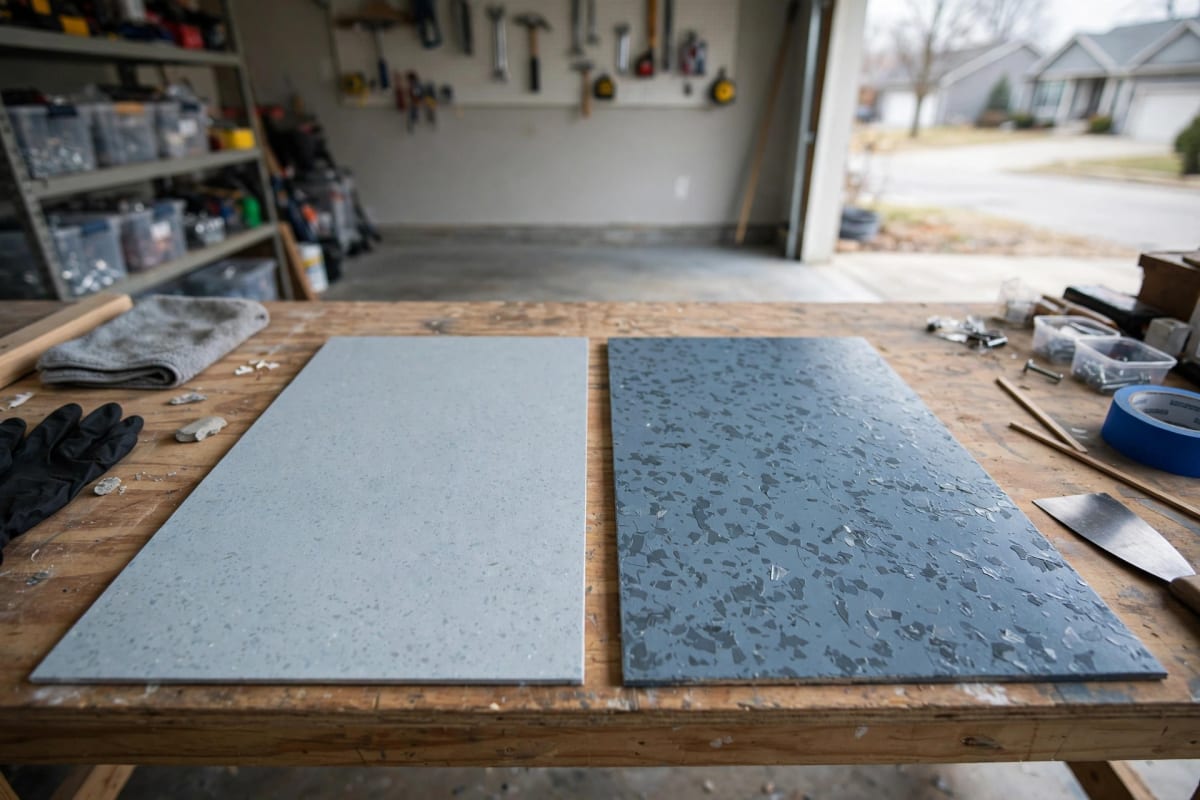
Epoxy vs. Polyurea Garage Floors: What's the Difference?
By In Des Moines · Epoxy Flooring · 5 min read
Get two quotes for a garage floor in Des Moines and you may get two different materials pitched as if they were the same thing. One installer talks about epoxy. Another talks about polyurea, or a polyaspartic topcoat, and the price is noticeably higher. They are not interchangeable names for one product — they are different coatings with different strengths, and the right choice depends on your concrete, your timeline, and how hard your garage gets used.
The short answer
Epoxy is the older, proven base coating: thick, hard, and strong, with a slower cure that usually means a two-to-three-day install before you park on it. Polyurea and its close relative polyaspartic cure much faster — sometimes same-day return to foot traffic — stay flexible, and resist yellowing from sunlight better than epoxy does. That is why many of the best residential systems are not either-or at all: they use an epoxy base for build and adhesion, then finish with a polyaspartic topcoat for speed, UV stability, and wear. If a quote just says "epoxy floor" or just says "polyurea floor," ask which layers are actually going down.
What epoxy does well
Epoxy has coated garage and shop floors for decades for a reason. It builds thick, which helps it level minor surface imperfections and gives the finished floor that deep, solid feel. It bonds very well to properly ground concrete, and in a full-flake system it carries the color broadcast that gives most Des Moines garage floors their finished look. It is also usually the lower-cost material of the two, which is why a professional epoxy system commonly lands in the $4 to $9 per square foot range we covered in our cost guide.
Its weaknesses are just as well known. Epoxy cures slowly, and it keeps curing — it gets harder and more brittle over time. It can yellow where sunlight hits it every day, which is why the strip just inside your garage door matters. And because it is rigid, a crack that moves in the concrete below can telegraph through an epoxy coating instead of being absorbed by it.
What polyurea and polyaspartic do well
Polyurea was developed for industrial use and later adapted for garage floors; polyaspartic is a type of polyurea formulated to give installers a workable pot life and a smooth finish. Both cure far faster than epoxy — a floor coated in the morning can often take foot traffic the same day and vehicles in a day or two, depending on the product and the weather. For a household that cannot give up its garage for the better part of a week, that timeline is a real advantage.
These coatings stay flexible after curing, so they move a little with the slab instead of cracking over small shifts — a genuine plus on Iowa concrete that goes through hard freeze-thaw cycles every winter. They also hold their color under UV light rather than ambering, and they resist hot-tire pickup, road salt, and common garage chemicals well. The trade-offs: the material costs more, the fast cure leaves less room for error during installation, and a thin polyurea-only system may not build the same thickness as an epoxy base. Fast is only better when the crew knows how to work at that speed.
The hybrid most good quotes actually describe
When you strip away the marketing, a lot of premium residential floors are hybrids: a moisture-tolerant epoxy primer and base coat for thickness and adhesion, a full broadcast of decorative flake, then a clear polyaspartic topcoat for UV stability and a faster return to service. That combination is not a compromise — it deliberately uses each material where it is strongest.
This is also where quotes get hard to compare. One bid may be a single-coat epoxy. Another may be a three-layer hybrid at nearly double the price. They will not wear the same, cure the same, or last the same, even though both sales pitches call the result a coated garage floor. Compare the layer list, not the label.
How to choose for your garage
- Timeline: If the garage has to be back in service fast, the polyaspartic topcoat earns its keep.
- Sun exposure: A south- or west-facing door that pours light onto the floor argues for a UV-stable topcoat.
- Moving cracks: Ask how the system handles cracks that open and close with the seasons; flexibility matters there.
- Budget: A well-prepped straight epoxy floor beats a rushed premium coating every time — prep still decides the lifespan.
- Use: Daily drivers, winter salt, and workshop use all push toward the more durable topcoat.
Whatever system you pick, the questions from our Epoxy Flooring Des Moines blog still apply: ask about diamond grinding, moisture testing, and what the warranty covers in writing. The material debate only matters after those basics are right.
The bottom line
Epoxy is thick, hard, proven, and usually less expensive, but slow to cure, brittle with age, and prone to yellowing in sunlight. Polyurea and polyaspartic are faster, flexible, and color-stable, at a higher material cost and with less forgiveness during installation. For most Des Moines garages, the strongest answer is the hybrid — epoxy underneath, polyaspartic on top. When you are ready to talk through which system fits your concrete, start at Epoxy Flooring Des Moines and get an answer based on your floor, not a label.
In Des Moines is a local team that builds and ranks websites for Des Moines service businesses. We write what we learn from real projects around the metro — straight answers, no sales pitch.
